By Catherine Adenle
If you’re wondering how AI is changing jobs, which skills employers will value, or how to keep your career moving forward, you’re asking questions workplaces and job seekers are asking.
The shift is already visible. In a 2025 Pew Research Centre survey, 21% of U.S. workers said at least some of their work involved AI, up from 16% about a year earlier. That does not mean every job is changing at the same pace. It does show why learning to work with AI is becoming a practical career skill.
See: About 1 in 5 U.S. workers now use AI in their jobs, up since last year
The World Economic Forum’s Future of Jobs Report 2025 offers another useful signal: employers expect 39% of workers’ current skills to change or become outdated by 2030. The report ranks AI and big data among the fastest-growing skills, alongside cybersecurity and technological literacy. It also highlights creative thinking, resilience, curiosity, and lifelong learning.
See The Future of Jobs Report 2025
That mix points to a clear career strategy: build AI fluency while strengthening the skills that help you make decisions, work with people and adapt.
AI skills extend beyond writing code or building machine-learning systems. In many jobs, useful AI fluency means choosing the right tool for a task, giving it clear instructions, checking its output, and using the result responsibly.
The World Economic Forum’s employer survey points to a broader skill set for the years ahead: technology skills, analytical thinking, creative thinking, flexibility, and a commitment to learning. These are employer expectations, not a guarantee that every role will require the same abilities.
See Skills Outlook at weforum.org
Learn what AI tools can do well, where they make mistakes and what information you should not enter into them. Start with a task you already understand, such as summarising public research or creating a first draft, and check every result before using it.
AI tools respond to the instructions they receive. Clear writing and speaking help you explain a problem, provide useful context and communicate results to colleagues or clients.
AI-generated content can sound confident even when it is incomplete or wrong. Check important claims against reliable sources, look for missing context and use your own judgement before acting.
You do not need to become a data scientist to benefit from stronger data skills. Learn to read basic charts, ask useful questions about a dataset and explain what a result means for your team or customers.
AI can help generate options, but people still need to decide which ideas are relevant, original and useful. Practise defining problems clearly and developing solutions that fit real needs.
Work tools and processes will keep changing. Make learning part of your routine: choose one skill to improve, practise it on a real task and review what worked.
Understanding colleagues, customers and stakeholders helps you spot needs that a tool cannot infer from a prompt alone. Listening well and building trust remain valuable across roles and industries.
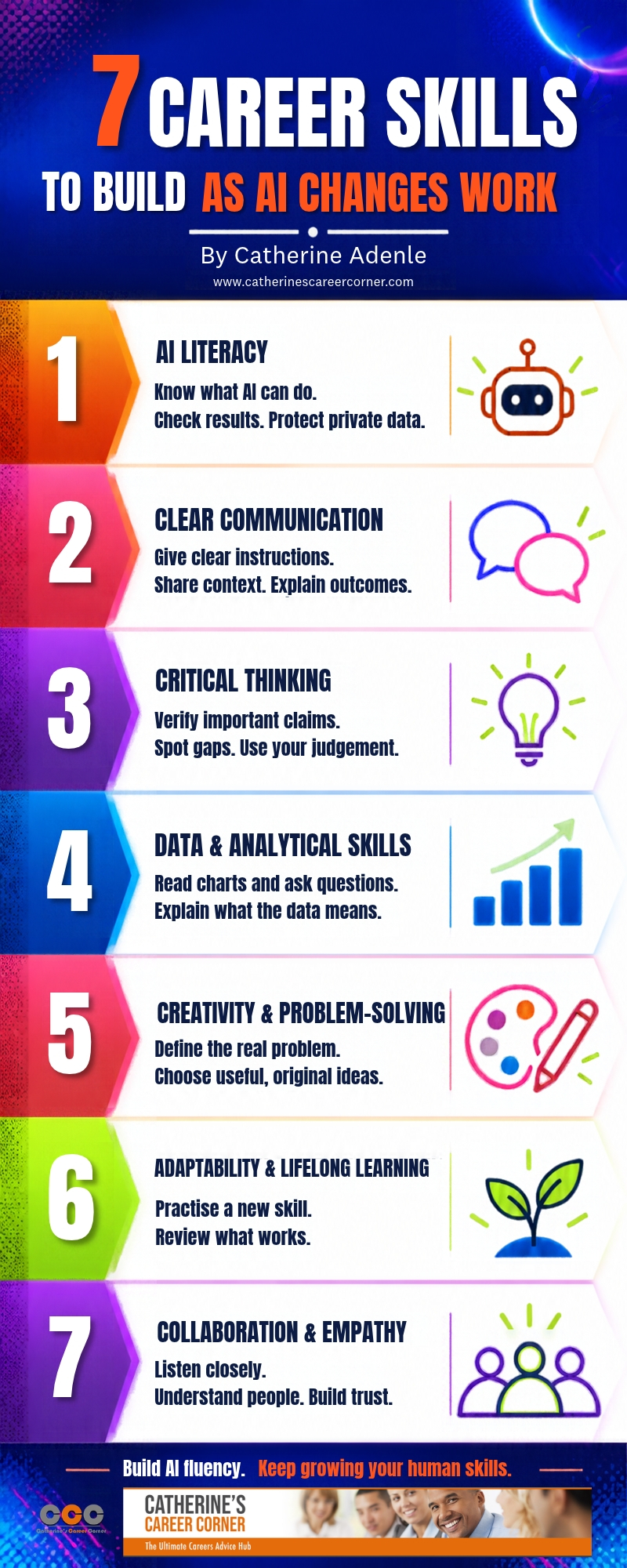
Infographic: 7 Career Skills to Build Now by Catherine Adenle
You do not need to master every new AI product. Start with a plan that connects learning to your actual work.
This approach gives you evidence of what you can do. It can also help you explain your skills in a performance review, job application or interview.
Be specific. A broad claim like “AI expert” tells an employer little. Describe the task, your judgement and the outcome.
For example:
Used an approved AI tool to organise public research, checked key claims against original sources and prepared a concise briefing for the project team.
Only include results you can support. If you can quantify the time saved or the quality improvement, explain how you measured it.
AI may automate or change some tasks, but the effect varies by role, industry and employer. Review the tasks in your job and learn where AI could assist, where human judgement is needed and what new skills your field is asking for.
Start with basic AI literacy: writing clear instructions, checking results, protecting sensitive information and understanding a tool’s limits. Then choose skills tied to your role, such as data analysis, research, writing or workflow automation.
Not necessarily. Coding is useful for some technical roles, but many people can build AI fluency through everyday workplace tasks without becoming programmers.
Analytical thinking, communication, creativity, adaptability, collaboration and empathy are useful across many kinds of work. The World Economic Forum also identifies several of these as core or rising skills in its employer survey.
Describe a real project or task where you used an AI tool responsibly. Explain what you did, how you checked the result and what changed. Do not claim experience or outcomes you cannot demonstrate.
Set a regular review, such as once each quarter. Check for changes in your role, tools and employer guidance, then choose one practical skill to practise.
AI skills can help you adapt, but career resilience comes from combining technical fluency with judgement, communication and a habit of learning. Pick one task you can improve this week, try an approved tool, and review the result carefully. Small, repeatable steps are a practical way to build confidence and show what you can do.
For a related perspective on job security and AI, see Catherine Adenle’s article, “Will AI Take My Job? Career Survival Guide Backed by Real Data”.
Video: How will AI impact the jobs market (BBC News)