The best leaders are no longer judged by how they manage people but by how they lead people through constant change.
By Catherine Adenle
If there is one management topic dominating boardrooms, leadership forums, and high-performing workplaces right now, it is change management.
Why? Today’s workplace is being reshaped by AI, hybrid work, cost pressure, skills gaps, employee expectations, and nonstop transformation. The old model of “announce a strategy and hope people follow” is broken.
Modern managers are now measured by one thing:
Can you turn uncertainty into momentum?
According to Gartner, one of the top leadership priorities for 2026 is helping leaders make change a routine rather than an occasional event. Their research notes organizations are significantly more likely to succeed when change becomes part of everyday work.
That makes this article timely, practical, and essential.
See Top HR Trends and CHRO Priorities for 2026
Why Change Management is the most sought-after management topic
Every organization is facing one or more of these realities:
- AI disrupting workflows
- New leadership expectations
- Team burnout and resistance
- Faster decision cycles
- Constant restructuring
- Skills shortages
- Hybrid collaboration friction
Harvard Business Review recently highlighted that many companies are struggling to turn AI investment into real value, proving that technology alone does not create transformation; people do.
See 9 Trends Shaping Work in 2026 and Beyond
That is the heart of change management.
Processes change systems. Leaders change people.
What is Change Management?
Change management is the structured process of helping individuals, teams, and organizations move from the current state to a better future state.
It includes:
- Communication
- Training
- Leadership alignment
- Behaviour adoption
- Managing resistance
- Reinforcement of new habits
- Measuring success
In simple terms:
It is not managing change. It is managing people through change.
Why most change efforts fail
Many managers treat change like an announcement.
They send an email.
Launch a presentation.
Rename the initiative.
Then wonder why nothing changes.
See 12 Reasons Why Employees Resist Change in the Workplace
Common reasons for change failures:
1. No clear “why”
People rarely resist change itself. They resist confusion.
2. Leaders talk, but don’t model
If leadership behavior stays the same, employees assume the change is cosmetic.
3. Too much change at once
Transformation overload creates disengagement.
4. No Emotional Intelligence
Fear, anxiety, identity loss, and uncertainty are real business issues.
5. No reinforcement
If old habits remain easier, teams revert instantly.
The new Change Management formula for great managers
1. Start with meaning, not metrics
Before KPIs, answer:
- Why now?
- Why this?
- Why us?
- What happens if we do nothing?
People follow purpose faster than spreadsheets.
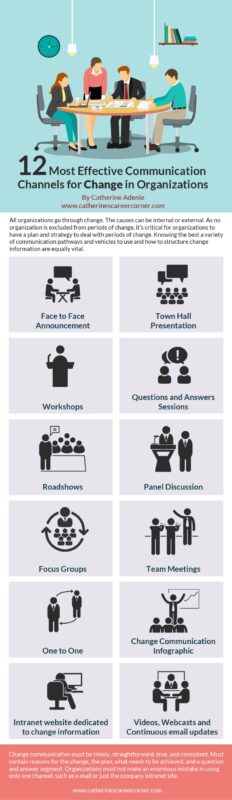
2. Communicate 7 Times, 7 Ways
One email is not communication.
Use:
- Town halls
- Team huddles
- Manager toolkits
- FAQ docs
- Video messages
- 1:1 coaching
- Informal conversations
Repetition creates clarity.
See the 12 Most Effective Communications Channels for Change
3. Equip middle managers first
Middle managers are the transmission system of business.
If they are confused, the organization stalls.
Train them first on:
- Talking points
- Handling resistance
- Coaching skills
- Escalation routes
- Emotional intelligence
4. Make wins visible quickly
Momentum beats theory.
Create early wins, such as the following:
- Faster approvals
- Less admin
- Better customer response times
- Simpler reporting
- Better team collaboration
Visible progress builds belief.
5. Reward new behaviours
What gets rewarded gets repeated.
Recognize:
- Adaptability
- Collaboration
- Innovation
- Ownership
- Learning mindset
Practical 30-Day Change Management Plan for Managers

Week 1: Diagnose
Ask:
- What are people worried about?
- What is unclear?
- Who influences culture?
Week 2: Clarify
Create a one-page change message:
- Why
- What
- When
- How
- Support available
Week 3: Activate
Run team sessions. Invite questions. Remove blockers.
Week 4: Reinforce
Celebrate wins. Share stories. Track adoption.
Leadership behaviours that win during change
According to Forbes, leadership priorities for 2026 include productivity, well-being, AI readiness, and stronger people leadership.
See The Workplace Changes That Will Demand Leadership Focus In 2026
That means successful managers must demonstrate the following:
- Calm under pressure
- Transparency
- Speed with empathy
- Decisiveness
- Listening skills
- Accountability
- Resilience
Employees may forget your presentation, but they never forget how your leadership made them feel during uncertainty.
Change Management in the AI era
AI is accelerating business change, but it also creates fear:
- “Will my role disappear?”
- “Do I have the skills?”
- “Is leadership replacing people?”
Managers must frame AI correctly:
AI should be positioned as follows:
- Productivity support
- Capability enhancement
- Better decision support
- Time recovery for higher-value work
Not simply headcount reduction.
That distinction determines trust.
Metrics Every Manager Should Track During Change
Use practical metrics:
| Metric |
Why It Matters |
| Adoption rate |
Are people using the new process? |
| Engagement score |
Is morale holding? |
| Productivity trend |
Is performance improving? |
| Manager confidence |
Are leaders equipped? |
| Attrition risk |
Are top people leaving? |
| Customer impact |
Is service improving or slipping? |
The biggest lesson for modern leaders
Change used to be seasonal.
Now it is continuous.
The best managers no longer “deliver projects.”
They build teams that can evolve repeatedly without losing energy, trust, or performance.
That is elite leadership.
5 common Change Management questions (Q&A)
1. What is the first step in change management?
Start with clarity. Explain why the change is needed and what success looks like.
2. Why do employees resist change?
Usually because of uncertainty, poor communication, fear of loss, or lack of involvement.
3. How long does successful change take?
Longer than leaders expect. Behavior change often takes months, not weeks.
4. What role do managers play?
Managers are the most critical layer because employees trust their direct leader more than corporate announcements.
5. How do I make change stick?
Reinforce new behaviors, simplify processes, reward adoption, and keep communicating.
Conclusion
Technology may transform systems.
Strategy may reshape direction.
But only leadership transforms people.
And in 2026, the managers who master change management will not just survive disruption; they will thrive.
They will lead the future.